
Most rooms we see online have a decent sofa, good lighting, nice art, and a rug that's one size too small. It sits in the middle of the floor like a bath mat, and it makes everything around it look smaller and cheaper than it is. The fix is rarely a different rug. It's a bigger one.
This guide gives you the sizes that work in each room, the measurements behind them, and the few rules we'd actually hold you to. Keep a tape measure nearby.
The quick reference
If you only read one thing, read this. These are the standard sizes that fit most American rooms. Use them as a starting point, then check your own measurements against the rules in each section below.
| Room | Common sizes | The rule behind it |
|---|---|---|
| Living room | 8' x 10', 9' x 12' | Front legs of the sofa and chairs sit on the rug |
| Small living room | 5' x 8' | Only when the room can't take an 8' x 10' |
| Dining room | 8' x 10', 9' x 12' | 24 inches or more past the table on every side |
| Round dining table | 8' or 10' round | Same 24-inch rule, measured from the table edge |
| Queen bed | 8' x 10' | Under the lower two-thirds of the bed |
| King bed | 9' x 12' | 18 to 24 inches showing on each side |
| Hallway | 2' x 8' to 2'6" x 12' runners | 4 to 6 inches of floor on each side |
| Entryway | 2' x 3', 3' x 5' | No wider than the door |
Living room: 8' x 10' is the default

Front legs on, always
The rug should be big enough that the front legs of your sofa and every chair in the seating group rest on it. That one detail ties the furniture together into a single conversation area. When every piece floats around the edge of the rug, the room reads as scattered.
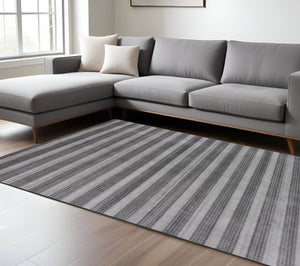
For a standard sofa and two chairs, that almost always means an 8' x 10' rug. The rug should also run a little past each end of the sofa, about 6 to 8 inches if you can manage it. A rug that stops short of the sofa arms looks undersized every time.
When to go up to 9' x 12' or larger
Sectionals, long sofas over 90 inches, and seating groups with four or more chairs usually need a 9' x 12' rug. In an open floor plan, the rug is doing extra work. It marks where the living room starts and the kitchen ends, so it can be large enough for every leg of every piece to sit fully on it.
Whatever size you choose, leave a border of bare floor between the rug and the walls. In an average room, 12 to 18 inches looks right. In a very large room you can leave more, and in a tight room you can go down to about 8 inches. Wall to wall feels like carpet. That's a different look, and not the one you're paying a rug price for.

The case for 5' x 8'
A 5' x 8' rug works in a small apartment living room or a reading corner, where an 8' x 10' would run into walls or doorways. In that case, keep it under the coffee table only and pull all the furniture legs off it, so the arrangement looks intentional rather than cramped. If you can fit the larger size, though, take it.
Shop the look
Living room rugs we'd start with
-
 Modern Ivory Wool Area Rug with Cotton Backing
-
 Blue and Black Oriental Power Loom Area Rug
-
 Ivory Contemporary Abstract Power Loom Area Rug
-
 Ivory and Black Wool Geometric Tufted Handmade Area Rug


Dining room: measure the table, then add 24 inches

The chair test
A dining rug has one job: keep every chair on the rug when someone pulls it out to sit down. If the back legs catch on the rug edge every night, the rug is too small, and it will start to curl and wear along that line.
So measure your table and add at least 24 inches on every side. Thirty inches is even better if your chairs are deep or have arms.
What that means in real sizes
- Six-seat table (about 72 by 40 inches): an 8' x 10' rug.
- Eight-seat table (about 96 by 42 inches): a 9' x 12' rug.
- Table with leaves in: size for the extended length if you use it more than a few times a year.
- Round table: a round rug that follows the same 24-inch rule. A 48-inch table takes an 8' round; a 60-inch table needs closer to 10'.
Choose a low pile or flatweave here. Chairs slide more easily, crumbs come out with one pass of the vacuum, and nobody's chair wobbles. Save the plush shag for the bedroom.
Shop the look
Easy-care dining room rugs
-
 Beige and Blue Floral Medallion Power Loom Area Rug
-
 Gray Floral Distressed Polypropylene Area Rug
-
 Beige Jute Hand Woven Area Rug, Solid Country Style
-
 Beige Moroccan Stain Resistant Polyester Area Rug


Bedroom: soft landing on both sides

Under the lower two-thirds
The goal in a bedroom is simple: your feet land on something soft when you get up. Slide the rug under the lower two-thirds of the bed, stopping a few inches in front of the nightstands, so the nightstands sit on the floor and the rug extends out past the foot of the bed.
Then check the sides. You want 18 to 24 inches of rug showing on each side of the bed. Less than that and the rug looks like it's hiding under the frame.
Sizes by bed
- Queen: an 8' x 10', turned so the 10-foot side runs across the width of the bed.
- King or California king: a 9' x 12'. A king on an 8' x 10' leaves too little rug showing at the sides.
- Full or twin: a 5' x 8' or 6' x 9' usually does it.
Short on floor space, or the bed sits close to a wall? Skip the big rug and put a runner along each side of the bed instead. You still get the soft landing for a fraction of the floor area.
Shop the look
Bedroom rugs with a softer hand
-
 Beige and Ivory Wool Striped Hand Tufted Area Rug
-
 Beige and Blue Floral Medallion Hand Loomed Viscose Area Rug
-
 Blue and Ivory Wool Floral Hand Tufted Loop Pile Area Rug
-
 Gray Shag Hand Tufted Area Rug with Cotton Backing


Hallways and runners: let the floor frame it

Width first
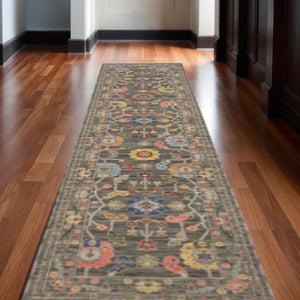
A runner should leave 4 to 6 inches of floor visible on each side. That strip of wood or tile is what makes it look like a runner and not hallway carpet. Most hallways are 36 to 42 inches wide, which puts you at a 2' or 2'6" wide runner.
Then length
Leave floor showing at both ends too, and keep the runner clear of door swings. An 8-foot runner suits a short hall or the space in front of a kitchen counter. Longer halls take a 10' or 12'. If your hall is longer still, two matching runners with a short gap between them look better than one runner that falls short.
Shop the look
Runners worth the walk
-
 Gray and Silver Oriental Distressed Runner Rug, 10'
-
 Orange and Ivory Genuine Wool Oriental Runner Rug With Fringe, 12'
-
 Silver and Gray Wool Striped Shag Hand Knotted Runner Rug
-
 Gray Red and Blue Floral Runner Rug with Fringe


Entryway: smaller than you think

No wider than the door
Inside the front door, the rug should be narrower than the door itself. A standard 36-inch door pairs well with a 2' x 3' or a 3' x 5' set lengthwise into the room. Before you buy, open the door all the way and check the gap underneath. A thick pile can catch the door bottom, so a low pile is the safer choice here.
Bigger foyers
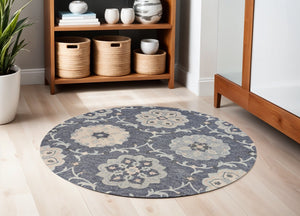
If you have a real foyer with a center table, a round rug is hard to beat. Size it so the table sits well inside the rug with at least a foot of rug around it, and keep a clear path from the door to the rest of the house.
Shop the look
Round rugs for foyers and breakfast nooks
-
 Blue and Red Traditional Oriental Round Rug
-
 Beige and Gray Round Abstract Power Loom Area Rug
-
 Ivory and Blue Traditional Oriental Round Rug


Measure before you buy
Five minutes with a tape measure saves you a return. Here's how we'd do it.
- Measure the room, not the old rug. Note the wall-to-wall dimensions, plus where doors, vents and floor outlets sit.
- Mark the floor with painter's tape. Tape out the exact outline of the size you're considering, corner to corner.
- Live with the tape for a day. Walk through the room, sit on the sofa, pull out the dining chairs. You'll know quickly if it feels cramped or skimpy.
- Check the clearances. Doors should swing freely over the rug, and you want the 12 to 18 inches of floor showing near the walls.
- Tape the next size up. If the first outline felt borderline, try the larger one. More often than not, that's the one you'll keep.
One more thing to plan for: a rug pad. It keeps the rug from sliding, adds cushion underfoot, and protects your floors. Buy it about 1 inch shorter than the rug on every side so the edges taper down cleanly.
Rug size questions we get asked most
Is it better for a rug to be too big or too small?
Too big, within reason. A rug that leaves 8 to 12 inches of floor around it still looks deliberate. A rug that floats in the middle of the furniture makes the whole room look smaller. If you're between two sizes, choose the larger one.
Should the rug go under the couch?
At least the front legs should. In most living rooms that means an 8' x 10' or larger rug, with the back legs of the sofa on the floor. In a larger room or an open plan, the whole sofa can sit on the rug.
What size rug do I need for a sectional?
Usually a 9' x 12'. Both arms of the sectional should have their front legs on the rug, and the rug should run a few inches past the end of each side. A small sectional in a compact room can work on an 8' x 10'.
What size rug goes under a king bed?
A 9' x 12', placed under the lower two-thirds of the bed with 18 to 24 inches showing on each side. For a queen, an 8' x 10' is the standard choice.
How wide should a hallway runner be?
Leave 4 to 6 inches of floor on each side. For a typical 36 to 42 inch hallway, that's a 2' or 2'6" wide runner. Choose the length so floor shows at both ends of the hall.